DRAFT Victims & Survivors Charter

Please note that this document is a draft version and might not reflect the final version. It will be developed through consultation and feedback

About this Charter

The Independent Inquiry into Grooming Gangs has been set up with a three-year remit, to examine what happened in cases of group-based child sexual exploitation (often referred to as “grooming gangs”), and how public authorities and others responded. Our role is to build a clear understanding of patterns, decisions, and failures, and to make recommendations for change.

This work is focused on victims and survivors of grooming gangs. Many victims and survivors were not protected when they should have been. Some were ignored, not believed, or made to feel responsible for what happened to them. Others came forward and were let down by the very systems that were meant to help. We understand why trust may not be there.

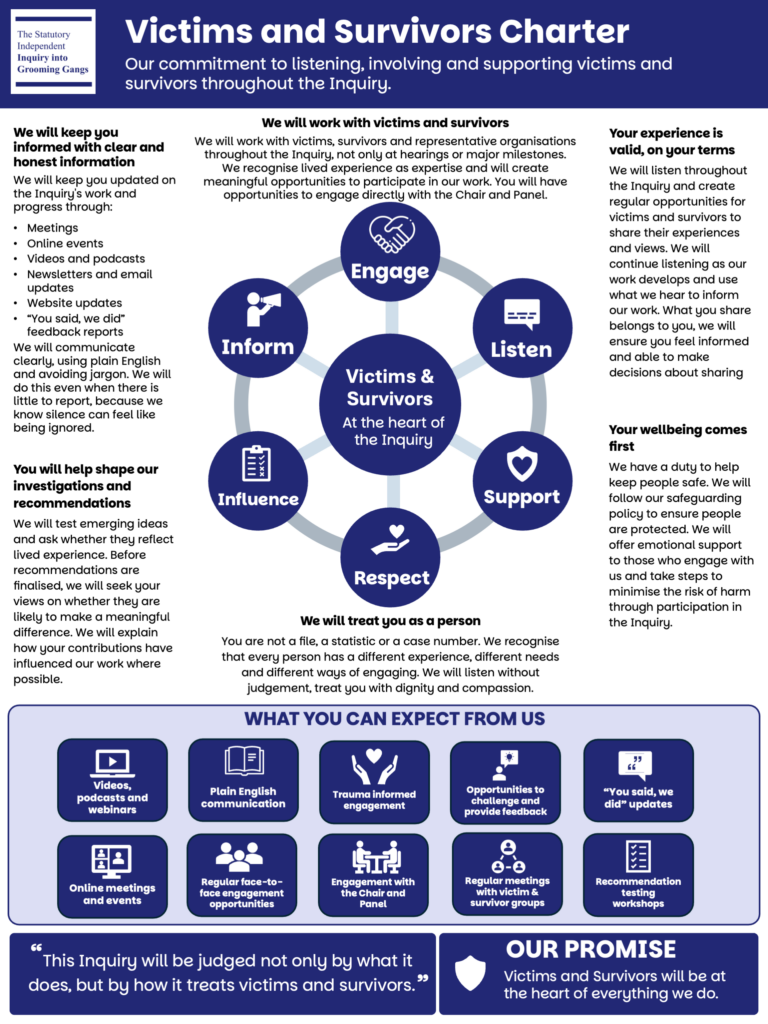
This Charter sets out how we will approach our work with victims and survivors, and what you can expect from us. Further detail on how this will work in practice is set out in the Inquiry’s Victims and Survivors Engagement Strategy, key parts of which will be published.

Victims and survivors will be at the heart of this work, and your experiences will shape how the Inquiry understands what happened and how it carries out its work.

Our commitments to victims and survivors

1. We will be clear about how you can contact us — and we will
respect your boundaries.

You are in control of whether you come forward. If you do, you decide what you share and what you don’t. You do not have to tell us everything. You do not have to continue if you don’t want to.


We will explain the different ways to engage with us in plain language—what each option is for, and what it isn’t. We will be clear about the difference between sharing your experience, submitting evidence, and giving testimony. If you need to pause or step away, that will be respected.

2. We will be straight with you about what happens to what you share.

You should not have to guess where your story goes or how it might be used. We will explain clearly how your information may be used, what it may contribute to, and what it will not lead to.

Not everything shared with us will lead to an investigation, hearing, or action — and we will say that upfront. But what you tell us will not be ignored or filed away. It will be used to help us understand patterns, failures, and the full picture — even where no direct action follows.

3. We will treat you as an individual, not a case.

There is no single “type” of victim or survivor. People’s experiences, backgrounds, and needs are different. We will not make assumptions about you or your choices. We will treat you with respect, without judgment.

Whether you engage with us or not, this Inquiry is still about what happened to you and others like you. Our work will not rely only on those who are able to come forward.

4. We will do this work in a way that does not cause more harm.

We recognise that contact with the Inquiry may bring distress, anger, fear, or memories people have worked hard to survive. We will not make this harder than it needs to be.

In practice, that means we will tell you what is happening in plain language, not leave you in the dark, and avoid processes that make things harder than they need to be.


This is not about treating people as fragile. It is about not repeating the kind of experiences where people were dismissed, not believed, or left confused about what was happening.

5. We recognise that the impact does not just stay in the past.

What happened does not neatly end. The effects can be long-term, and sometimes affect families and relationships over time. We will not talk about this as something that is “over”.

We will reflect the reality of ongoing impact in how we listen, how we analyse evidence, and how we report on what happened.

6. We will be honest about what this Inquiry can and cannot do.

We will not overstate our role. This Inquiry cannot decide criminal guilt or civil liability. It cannot investigate everything, and it cannot fix every failure.

We will explain our role, including how it relates to criminal investigations, and where the limits are. Being clear about this is part of treating people with respect. We will be clear about what stage we are at, what is happening next, and where there may be limits or delays.

7. We will take safety seriously, even when it is difficult.

If you come forward, your safety matters. What you tell us will be kept confidential, unless there is an immediate risk of serious harm to yourself or others. If that happens, we will explain this clearly and carefully, including what this means, what might happen next, and what support is
available.

8. If we get it wrong, we will not ignore it.

We will not get everything right. If you feel we have let you down, there will be a clear way to tell us. We will explain how to raise concerns, respond properly and fairly, and use what we learn to improve how we work. Accountability is part of earning trust.

Final note

You may have heard promises like these before and still been let down. This Charter is not asking you to trust us. It is setting out what you can expect from us.

Trust, if it comes, will come from what we do — not from what we say.